

The Creeping Hand: Against Progressive Taxation
Published 29th December 2025
Progressive taxation is widely presented as a neutral, scientific, and morally necessary tool to promote fairness and welfare. Yet its premises are philosophically fragile, empirically false, and politically dangerous.
- It replaces equality before the law with fiscal discrimination,
- prevents self-sufficiency,
- denies the natural right to property,
- presumes an arbitrary hierarchy of needs,
- and imposes a model of human behaviour unsupported by any observable evidence.
In Belgium, its effects are especially severe: an extremely narrow “allowed” net-income corridor and one of the world’s highest marginal tax rates together create a structural obstacle to saving, investing, and achieving independence from the state.
This article argues that progressive taxation is a mechanism of subordination — unscientific, unjust, and fundamentally corrosive to prosperity.
IN BRIEF
Progressivity is discriminatory: equal individuals are treated unequally before the law. It creates second-class citizens — the providers — who are compelled to serve those favoured by privilege.
Progressivity is arbitrary. It violates the natural right to property by claiming that some portion of income is at the disposal of the state by default, often the largest portion.
Marginal utility theory cannot justify progressive taxation: subjective preferences cannot be centrally assessed, and observable behaviour contradicts the model.
- Life plans differ (family size, savings goals, risk appetite), making any uniform marginal schedule arbitrary and unjust. Utility functions are neither identical nor necessarily continuous.
- Progressivity disregards the lifetime structure of needs, disproportionately penalising labour income — the most fragile and time-limited source of rent.
- In practice, Belgium’s system traps individuals in high tax wedges, double taxation, and near-confiscatory marginal rates.
Progressivity is a major obstacle to welfare: it creates moral hazard, destroys incentives, undermines capital formation, and thus employment and long-term growth.
Progressivity is a historical anomaly — a wartime instrument normalised into peacetime dogma.
What is marginal utility? What is progressive taxation?
In economics it is assumed that additional quantities of a certain good or service increase the utility to the individual less than the precedent unit. The theory presumes a continuum of utility, a curve where at any given point the satisfaction provided by a subsequent unit is lower than its precedent. Thus, marginal utility is deemed degressive.
Progressive taxation adopts the idea of marginal utility to argue that additional units of tax do harm less the taxpayer in function of their rent (the lower the rent the higher the harm). It implicitly establishes that the comparison of utilities is possible and legitimate.
1. A DISCRIMINATORY SYSTEM
Progressivity vs Equality Before the Law
Equality before the law is the foundation of any free society. Progressive taxation breaks this principle explicitly: two individuals performing the same action — earning one euro — are treated differently depending on their past income. No additional rights accompany the higher burden.
From a rule-of-law perspective, equal treatment would require that each citizen contribute equally in absolute terms to the financing of public goods, since rights and obligations are meant to be universal. Progressive taxation replaces this with a moralised fiction: some citizens owe more, not because they consume more public goods or enjoy more rights, but because the state deems their resources less valuable to them.
This is discrimination in the strict sense.
Political consequences
Politically, the logic of decreasing marginal utility legitimises large-scale social engineering: redistribution from higher earners to lower earners. In practice, it entrenches a system in which majorities democratically sanction the legal expropriation of minorities. Individuals are deprived of equal rights solely on account of higher income — a criterion that escapes moral scrutiny precisely because it is not tied to immutable characteristics.
The result is the proliferation of ad hoc fiscal rules, the erosion of limits to authority, and the transformation of taxation into a tool of arbitrary power. Such a system produces its fruits: it establishes an oligarchy of political parties who argue that the very system that exploits citizens is there to protect them, while creating a network of privileged social estates (public employees, civil servants, political representatives, and not least, the plebs). Further, progressivity opens the door to application laws depending on the characteristics or attributes of the person (for instance, social status, gender, etc.). Justice ceases to be blind when it starts weighing incomes.
2. NATURAL RIGHT TO PROPERTY
The argument for progressivity rests on the claim that “a euro means less to a rich person than to a poor person.” Even if this were true — and it cannot be measured — a difference in utility does not justify confiscation. Otherwise, the same reasoning would justify expropriating any good from someone deemed to need it less.
Property rights do not depend on subjective utility, but on legitimate acquisition. By tying taxation to hypothetical utility, the state asserts prior ownership over income unless it judges that income to be “needed” by its earner.
Belgium’s system makes this explicit: the first €10,910 of annual income are exempt, everything beyond that is subject to progressive claims. What remains of private property is therefore conditional, revocable, and politically determined. Progressive taxation exacerbates existing tax theft. It applies a higher gradient.
3. THE MARGINAL UTILITY FALLACY: AN UNSCIENTIFIC JUSTIFICATION
Progressive taxation relies on a nineteenth-century abstraction: declining marginal utility of money. This justification fails on three grounds.
First, subjective preferences cannot be measured ex ante. Individuals value income differently depending on risk tolerance, cultural norms, ambitions, family structure, and life-cycle needs. These differences are observable through behaviour: some choose leisure over income, others sacrifice leisure for earnings; some select meaningful but lower-paid professions, others prioritise remuneration. Utility functions differ across individuals and cannot be standardised.
Second, empirical behaviour contradicts the theory. If marginal utility declined predictably, high-income individuals would routinely relinquish the majority of their income voluntarily. They do not. The share of income individuals are willing to give up varies widely, demonstrating that marginal valuation is neither uniform nor aligned with progressive tax schedules.
Third, the theory ignores thresholds and time. Many needs are discrete and cumulative: housing, family support, retirement security. Utility does not decline smoothly; it often follows a stepped pattern. Before basic lifetime needs are met, additional income retains high utility. Progressive taxation, by assessing utility annually rather than over a lifetime, confiscates resources before sufficiency is achieved.
Fourth, progressivity is applied arbitrarily. If decreasing marginal utility were applied consistently, it would justify total levelling on income. Without coherence there is only arbitrariness left. Social democracies reject total levelling, but progressive tax brackets remain applicable. This denotes clearly the unbound power of the authoritarian societies we live in.
4. PROPORTIONALITY VS PROGRESSIVITY
Proportional and progressive taxation are often conflated. Under a proportional system, higher earners already pay more in absolute terms. A 20% flat tax implies that someone earning €100,000 pays ten times more than someone earning €10,000.
Under a progressive system, the disparity increases further without granting additional rights or services. Progressivity is not fairness; it is discrimination amplified.
5. DIFFERENT LIFE PROJECTS, ONE SCHEDULE
Individuals pursue different life goals: early retirement, large families, entrepreneurship, artistic careers, spiritual discovery, geographic mobility, or wealth accumulation. A free society allows these choices. Progressive taxation does not.
By imposing a single utility curve on all citizens, it overrides individual life strategies in favour of ideological uniformity.
6. PROGRESSIVE TAXATION IN PRACTICE: BELGIUM
Belgium exemplifies how progressive taxation becomes a system of structural dependence. Income is taxed repeatedly — through income tax, social contributions, consumption taxes, property taxes, and withholding mechanisms — such that net income is rarely final.
High marginal rates apply early, punishing labour income and discouraging effort. Paired to an extensive, uncontrolled social security system, the incentives to work vanish. The inability to accumulate capital forces reliance on public systems that are themselves financially fragile, particularly pensions.
The economic outcome is a vicious cycle: no capital formation, reduced investment, stagnating productivity, declining real wages, and increasing dependency — followed by calls for further redistribution.
7. HISTORICAL AND COMPARATIVE NOTE
Progressive taxation is not timeless. It expanded during wars and fiscal crises and became permanent only in the post-war period, when states began appropriating 35–55% of GDP instead of the historical 10–20%.
By contrast, many countries — notably in the Baltics and Central Europe — have adopted flat or near-flat income taxes and achieved strong growth and convergence. Progressivity is therefore neither inevitable nor necessary.
8. WITHIN THE SYSTEM: LIFETIME ALLOWANCES
If progressive taxation were taken seriously on its own terms, exemptions would be assessed over a lifetime, not annually. Only once basic lifetime needs are secured could declining utility plausibly be invoked.
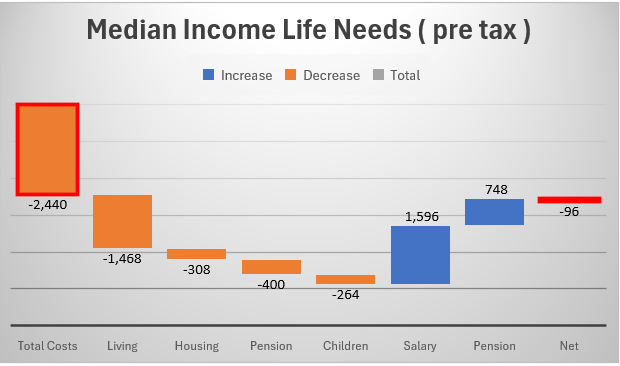
Under current systems, progressivity applies long before such thresholds are met.
CONCLUSION: WHO BELONGS TO THE MIDDLE CLASS? A TYRANNICAL IDEAL OF EQUALITY
No system of control leaves language untouched. Before confiscation comes redefinition.
As 1984 puts it with brutal clarity: “The purpose of Newspeak was not only to provide a medium of expression for the world-view and mental habits proper to the devotees of Ingsoc, but to make all other modes of thought impossible.”
In Belgium, “poor,” “middle class,” and “rich” have become administrative labels rather than descriptive terms — political labels adjusted to fit the fiscal needs of the state. The infamous “Who belongs to the middle class?” graph makes this explicit. The middle class is compressed into a razor-thin corridor of net monthly income, while modest deviations are stigmatised as excess.
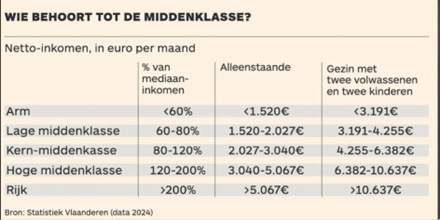
The definition is purely relative. It abstracts entirely from cost-of-living differentials, housing and rental burdens, life-cycle income smoothing, pension adequacy, household composition, wealth accumulation, and disposable income after mandatory contributions. In economic terms, it ignores both intertemporal constraints and real consumption capacity, focusing exclusively on a static distributional snapshot.
An individual earning €5,000 net per month — still dependent on labour and exposed to unemployment or pension risk — is deemed rich. This redefinition prepares the ground for unlimited taxation.
Once the middle class is labelled rich, progressive taxation no longer requires justification. It simply unfolds. That is the function of the labels.
Every euro above the median becomes excess.
Every breath beyond subsistence becomes unfair.
Every space of freedom becomes suspect.